A natural hairline should not look the same for every patient. That is why, before performing a hair transplant at Maritime Hair Center in Gdańsk, we carefully assess facial anatomy, the extent of hair loss, the density of existing hair, the patient’s age, and their expectations. Only then do we design a new hairline tailored to the individual.
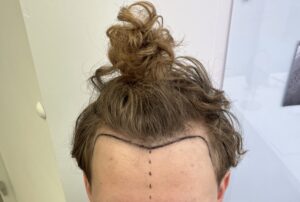
The photo shows one of the stages of preparation for the procedure: the planned hairline, which serves as a guide for positioning the transplanted hair follicles.
Why don’t we design the same hairline for everyone?
Every patient has a different facial structure, forehead proportions, and history of hair loss. Hair density and thickness also vary from person to person.
For this reason, we do not use a single, universal hairline design. A hairline that looks good on one person may not be suitable for another.
Our goal is to design a hairline that complements the patient’s facial features and looks natural.
What do we consider when designing a new hairline?
Facial anatomy and forehead muscle movement
This is one of the important elements of treatment planning. We assess facial proportions, forehead shape, and the anatomy of this area, also taking into account the movement of the muscles involved in facial expressions.
Why does this matter? The new hairline should look natural both when the patient’s face is relaxed and when they raise their eyebrows or furrow their forehead.
It is therefore not simply a matter of drawing the right shape on the skin. We must also consider the patient’s anatomy and plan graft placement carefully to avoid an unnatural aesthetic result.
Density and distribution of existing hair
Before a hair transplant, we also assess the hair the patient still has, paying particular attention to its density and thickness.
This is especially important when restoring the temples, lowering the hairline, or increasing density in thinning areas.
The transplanted hair should blend harmoniously with the existing hair. That is why we plan not only the shape of the hairline but also how the hair follicles will be distributed within it.
The patient’s age and the future of their hair
When planning a hair transplant, we also consider the patient’s age and the progression of their hair loss so far.
A hairline designed solely to suit the patient’s current appearance may not be the best long-term solution. Hair loss can progress in some patients, so it is important to account for possible future changes.
Our aim is to create a hairline that remains appropriate not only now but also in five, ten, or more years. For this reason, we do not always recommend lowering the hairline as much as possible.
The patient’s expectations
Every patient comes to us with different expectations. One person may primarily want to restore their temples, another may prefer a lower hairline, while someone else may wish to recreate the look they had several years ago.
During the consultation, we discuss the result the patient hopes to achieve and what matters most to them.
We then compare these expectations with their anatomical characteristics and the available donor area. This allows us to develop a realistic treatment plan tailored to the individual.
Photographs of the patient from previous years
If the patient has photographs of themselves from earlier years, we are happy to review them. They can be a valuable reference when planning a new hairline.
These photographs can help us understand the original hairline’s shape, position, and how the hair naturally grew.
This does not mean that we always recreate the original hairline exactly. Instead, we treat these photographs as an additional source of information that helps us better understand the patient’s expectations and plan an appropriate result.
How do we design a hairline at Maritime Hair Center?
We begin with a consultation and an assessment of the patient’s individual situation. We examine facial anatomy, existing hair, the areas requiring restoration, and the capacity of the donor area.
Next, we mark the proposed hairline on the scalp. At this stage, the patient can see the suggested shape and discuss it with our team before the procedure.
This is an important step because it allows us to assess the proportions together, discuss expectations, and refine the design if necessary.
Only after considering all these factors do we establish the final treatment plan for the FUE hair transplant procedure.
Why does a natural-looking result start with good planning?
Even when a hair transplant is performed correctly, careful planning of the hairline is essential. Its shape and position, the transition into the temple areas, and graft distribution all play an important role in the final appearance.
A hairline that is too straight, too low, or poorly suited to the patient’s face may look unnatural. An individual approach, on the other hand, allows us to tailor the design to the patient’s features and plan a harmonious result.
At Maritime Hair Center in Gdańsk, we consider hairline design an essential stage of the entire process. We do not simply copy standard templates. Instead, we carefully assess each individual case and plan the procedure based on facial anatomy, existing hair, and the patient’s expectations.
